Domenico Tempesta’s life story
I Know This Much Is TrueDomenico Tempesta’s life story is both a physical family artifact and an attempt to put a troubled past into order. Dictated and then written in stages, it was kept private by its author, recovered after his death by Ma, and eventually passed to Dominick and Thomas. Its contents make the family history less secure rather than more settled: for Dominick, the manuscript revises the image of a heroic grandfather and opens new questions about Ma’s parentage and the family’s inheritance of harm.
Form and Contents
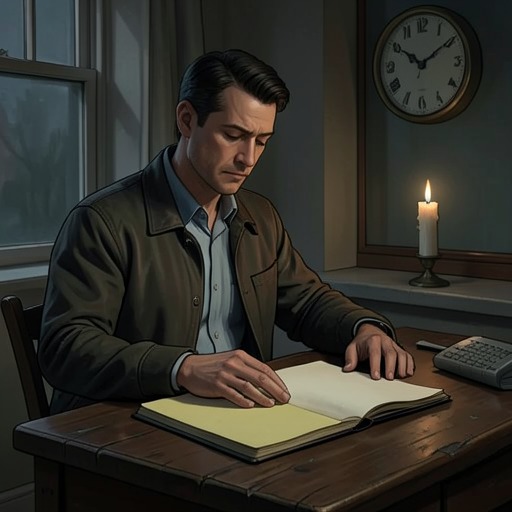
The surviving manuscript is a thick sheaf of paper kept inside a large manila envelope. Its first ten or fifteen pages are typewritten, including originals and carbon copies; the remaining pages are handwritten in an ornate blue-ink script. A small coverless dictionary was stored with the papers, held in place by an elastic band. The manuscript’s title page identifies it as The History of Domenico Onofrio Tempesta, a Great Man from Humble Beginnings and dates it 8 July 1949. Its mixed formats preserve traces of composition as well as the life story itself: the account is not a single uninterrupted record, but a text assembled through dictation, transcription, and writing by hand.
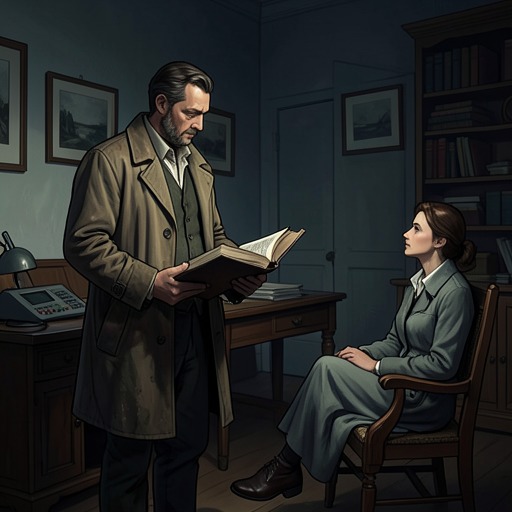
In the autobiographical account, Domenico explains that Father Guglielmo had assigned the writing as penance after a confession. He was to record what he had said, arrange it chronologically, and reflect on forgiveness and humility. Father Guglielmo urged him to write in a language he could manage: either the scholarly Italian he had learned in Rome or the Sicilian dialect of his childhood. Domenico protested that writing English was difficult for him, but the priest told him that the language mattered less than completing the task in good faith. The manuscript’s purpose was therefore not simply to preserve events. It was meant to make recollection orderly and to prompt reflection on anger, pride, and forgiveness.
A Difficult and Private Composition
The effort to produce the account was repeatedly interrupted. Domenico recalled writing only a page at a time, sometimes with a week or two between pages, because he was busy and disliked reopening painful subjects, including his father’s death in a mine, Uncle Nardo’s influence over his life, and the loss of his father’s gold medal. He bought a strongbox and locked away what he had written, wary of leaving such personal material where others could find it. When Father Guglielmo asked about the project, Domenico sometimes exaggerated his progress, even claiming that he had reached the halfway point of his life story.
He also tried a more elaborate dictation arrangement, involving a stenographer, a Dictaphone, and separate rooms for the speaker and the person taking dictation. That system lasted about a week. Domenico had misunderstood the rental cost: what he thought was eight dollars per week was actually eight dollars per day, amounting to forty dollars a week. He ended the rental, and he and Angelo Nardi wheeled the equipment onto the front porch, where it remained for two days before it was collected. Domenico then returned to dictating directly to Angelo, but Ma recalled that this method did not work any better than the first attempt. The account’s planned orderliness thus depended on a process that was itself stop-start and difficult to sustain.
Near the end of his life, Domenico told Ma that he was almost finished. She had previously known little about the project because he had not discussed it directly with her. When she asked what he would do with the manuscript, he said he might burn it after completing it. Ma later remembered hearing him weep that morning but did not approach him, fearing that doing so might anger him or make matters worse. When she brought him lunch, she found that he had died after a stroke; pages had blown or scattered among the hedges and against the chicken coop. The private text had nearly disappeared into the outdoor disorder from which Ma gathered its surviving pages.
Recovery and Transmission
After Ma’s death, the manuscript remained unread by her. She had kept her father’s history, but never got to read it herself. Before she died, she passed the strongbox’s contents to Dominick and Thomas. When Dominick opened it, he found the papers and learned from Ma that they contained her father’s life story, dictated in the summer he died. The revelation joined the manuscript to a loss on either side of its making: Domenico had left a guarded account behind, and Ma died without knowing its contents.
Dominick had the Italian manuscript translated and later told Thomas that Ma had given it to both of them. Thomas repeated the reference to their grandfather, then asked to walk down to the water instead of continuing the conversation. Dominick had hoped to discuss what he was reading, but Thomas’s brief response did not develop into that exchange. The manuscript had crossed generations and languages, yet its arrival did not ensure that the brothers would read or respond to it in the same way.
Reading and Family Consequences
For Dominick, the translated life story disrupts Ma’s repeated presentation of Domenico as a great man. He describes what he reads as showing a meaner, more troubling figure. The stories provoke questions about family conduct and identity, including whether Ma had been treated as if she were not Domenico’s daughter and whether the family’s account of her parentage could be trusted. These are Dominick’s suspicions and interpretations as he reads, not conclusions the manuscript alone confirms. His response shows how an inherited document can supply evidence while also multiplying uncertainty.
The account also changes how Dominick sees his own resemblance to his grandfather. He connects his appearance to the sepia photographs Ma rescued from the burning house and wonders what the likeness means if Domenico’s suspicions about Ma’s parentage were correct. He considers whether Domenico’s hostility toward Ma might have been bound up with a belief that she was someone else’s child. In this reading, the manuscript does not merely add information about the past; it gives Dominick a possible explanation for old injuries while making the family’s underlying story harder to establish.
Significance as a Family Record
The manuscript’s significance lies partly in the gap between its intended order and its actual passage through the family. Father Guglielmo asked Domenico to place beginning, middle, and present in sequence, but the surviving object bears the marks of interrupted labor: typed pages beside handwritten ones, fragments locked away, and papers scattered at the moment of their author’s death. It was a private act of recollection that became a legacy without its author’s control over who would read it or how they would interpret it.
Its transmission is equally uneven. Ma preserved the life story but died before reading it; Dominick had it translated and found it at once illuminating and disturbing; Thomas heard that it existed but redirected the conversation. Through these different encounters, Domenico Tempesta’s life story becomes more than a record of one man’s memories. It is a contested family archive, capable of challenging a heroic image and prompting questions that its pages cannot, by themselves, finally resolve.